
Language Access
Deliver notices, reminders, answers, and self-service in 100+ languages, automatically, so limited English proficiency never becomes a missed court date. eCourtDate helps agencies meet Title VI obligations without translating by hand.
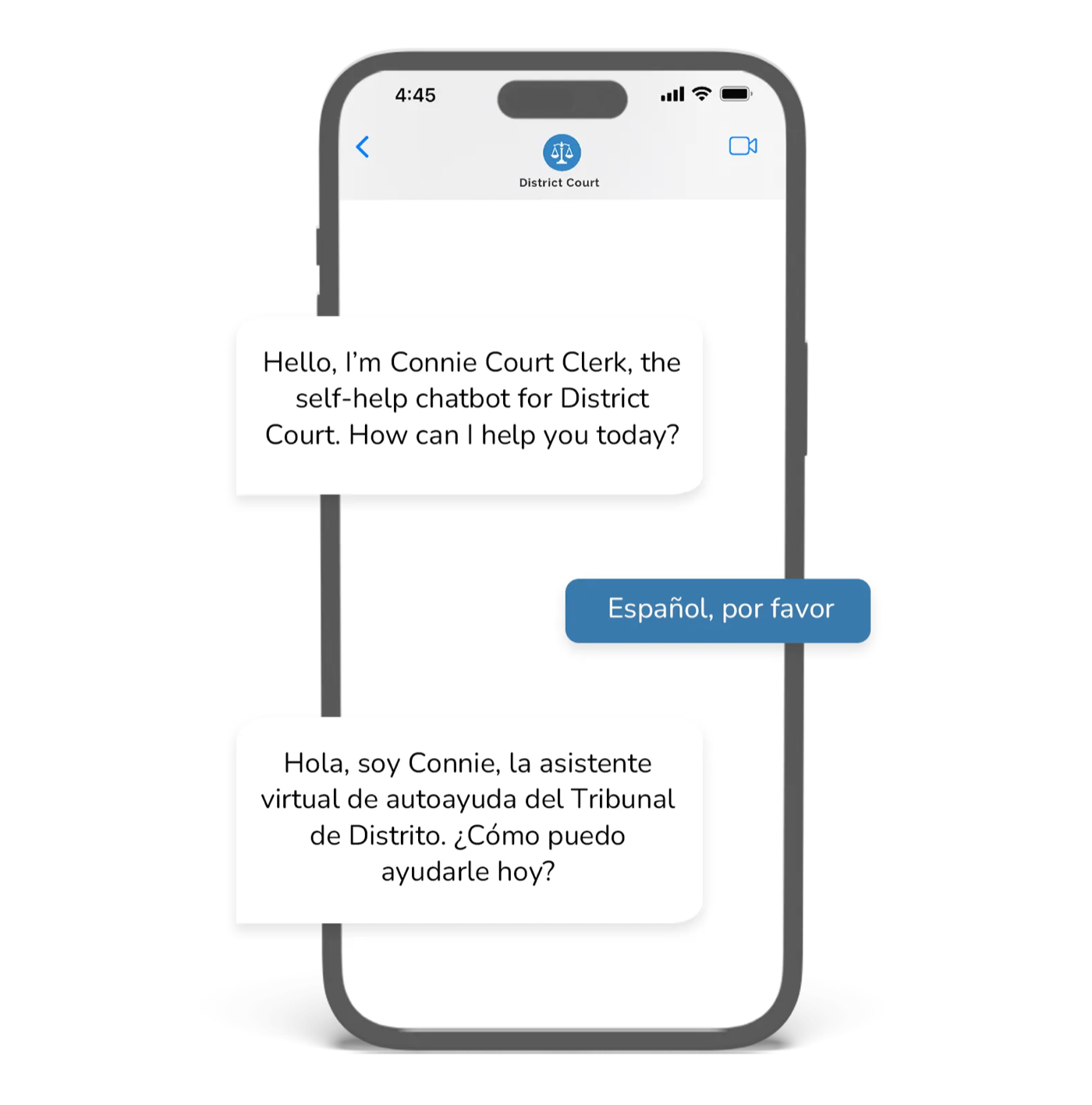
Serve every person in a language they understand
Serve people with limited English proficiency at every touchpoint, in a language they understand, without manual translation work.
A notice no one can read is not notice
People miss court dates they never understood they had. English-only notices quietly drive failure to appear (FTA), warrants, and fees for people who would have shown up.
Language access is a legal obligation
Courts receiving federal funds must provide meaningful access for people with limited English proficiency under Title VI. Meeting that duty with manual translation and ad hoc interpretation strains every request.
Interpreters are scarce and expensive
Certified interpreter hours go to routine questions, where is my courtroom, how do I pay, that could be answered automatically, instead of to the hearings that truly need them.
Translation by hand does not scale
Staff translating notices one at a time, or pasting legally significant text into consumer tools, is slow, inconsistent, and risky.
From your case data to the outcome
- 01
Capture the language
Each person’s preferred language is captured at intake or detected automatically, and follows them across every product and channel.
- 02
Deliver in their language
Reminders, notices, and documents go out in the recipient’s language across SMS, email, and voice, in 100+ languages, automatically.
- 03
Answer questions 24/7
Chatbots and AI voice answer routine questions in the caller’s language, and portals let people see their case, forms, and balances in their own language.
- 04
Keep every channel accessible
Interfaces meet WCAG 2.2 AA, messages use plain language, and every delivery is logged, so access is provable, not assumed.
What it does
Automatic Language Delivery
Notices, reminders, and alerts delivered in each recipient’s preferred language across every channel.
Multilingual Chat & Voice
AI chatbots and voice assistants answer routine questions in the caller’s language, 24/7.
Self-Service in 100+ Languages
Portals and guided forms let people see their case and act on it in their own language.
Accessible by Design
WCAG 2.2 AA interfaces and plain-language content, so access covers disability and literacy, not just language.
Delivery Logging
Every translated notice and interaction is logged, so language access is documented and reportable.
No one misses court because of the language
Every notice arrives in a language the person can read, every question has an answer they can understand, and every form can be completed without a translator standing by. Interpreter hours go to hearings instead of hallway questions, the agency can document that access was provided, and the no-shows that were really language failures stop happening.
100+
Languages delivered automatically
WCAG 2.2 AA
Accessibility standard across the platform
10,000+
Courts and justice locations on eCourtDate
What powers this work
This outcome runs on products you can adopt together or one at a time. Every product shares the same data, security, and integrations.
Messaging & Court Reminders
Behavioral, multi-channel reminders that cut failure-to-appear rates and keep every case moving.
Learn moreAI Chatbots & Voice
Answer the public 24/7 across chat, voice, email, and text, in 100+ languages, without adding staff.
Learn moreWeb Portals
Branded self-service portals for case info, documents, payments, files, and check-ins.
Learn moreForms & Submissions
A full forms builder with conditional logic: collect, manage, and route submissions into workflows.
Learn moreDocument Generation
Generate court documents from templates or AI, collect signatures, and deliver by portal, email, or your own printers and postage meters.
Learn more
Compliant, accessible, and accountable by default
Every capability runs on the same government-grade foundation. See the security overview.
CJIS compliant
On AWS GovCloud, with SSO, role-based access, and complete audit trails.
TCPA & opt-in
Consent, opt-out, and quiet-hours enforced automatically on every send.
WCAG 2.2 AA
Accessible to the public across every interface and channel.
100+ languages
Automatic detection and translation on every message and portal.
Frequently asked questions
Common questions about language access with eCourtDate.
How does eCourtDate support Title VI language access?
How many languages are supported?
How is a person’s language determined?
Does this reduce failure to appear?
Does it replace court interpreters?
Can eCourtDate connect to the systems we already have?
Built for these agencies
State Court Administration
State offices need statewide consistency, centralized analytics, and the ability to deploy programs across hundreds of courts simultaneously.
Municipal & Justice Courts
High-volume courts with limited staff need automation that works from day one. eCourtDate handles the repetitive work so clerks can focus on the people in front of them.
County & District Courts
Multi-department courts managing complex case types need a platform that coordinates work across divisions, judges, and locations.