
Statewide court platform for state court administration
Administrative offices of the courts need statewide consistency, centralized analytics, and the ability to deploy a program across hundreds of courts at once. eCourtDate provides central configuration, local flexibility, and cross-jurisdiction data, so a proven program scales statewide without local IT.
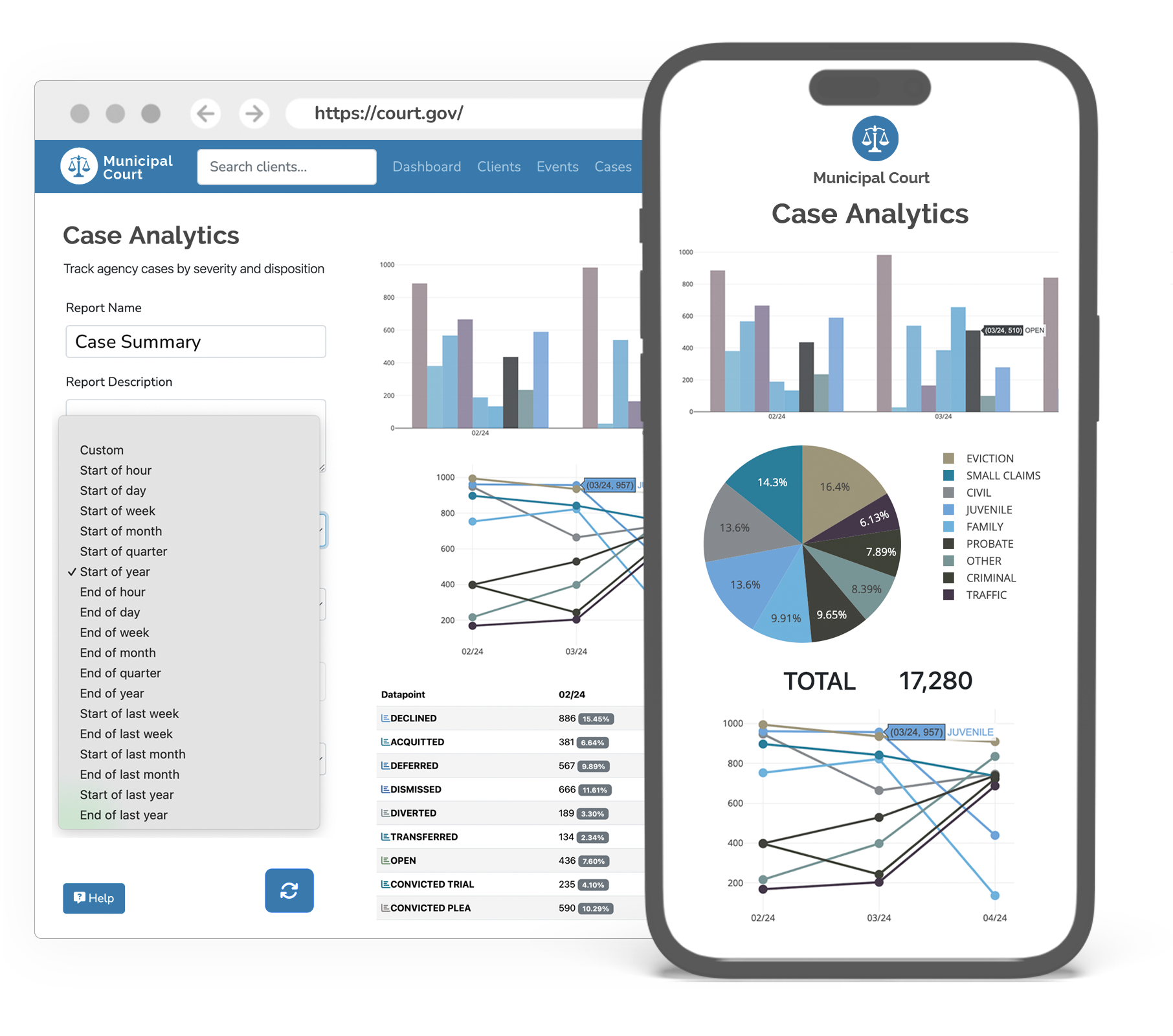
Built for state court administration
eCourtDate is built for state court administration: the administrative offices of the courts (AOCs) and state-level program offices responsible for consistency, evidence, and scale across every court in the state. These offices have to standardize practice across hundreds of local courts, measure what is working, and deploy proven programs without depending on local IT capacity. eCourtDate gives state administrators central configuration, statewide analytics, and one compliant platform every court can run.
State court administrators and AOC leadership
Set statewide standards once and deploy them to every court, with local flexibility where the law requires it.
Statewide program managers
Roll out reminder, payment, or supervision programs across jurisdictions and measure results from one place.
Research and policy analysts
Aggregate cross-jurisdiction data for evidence-based policy, funding requests, and legislative reporting.
State CIOs and CISOs
Provide a single CJIS-compliant platform on AWS GovCloud, removing the burden of every county standing up its own.
The work piling up behind the docket
Every county runs something different
Local courts operate their own systems and processes, so practice varies widely across the state and standardizing it is operationally complex.
No statewide visibility
Without centralized data, the state office cannot measure program effectiveness, compare jurisdictions, or allocate resources based on evidence.
Proven programs are hard to scale
A program that works in one county needs infrastructure, configuration, and support to reach the rest of the state, and most local courts have little IT capacity to add.
Reporting is slow and manual
Legislative, funding, and compliance reports are assembled by hand from inconsistent local data, which makes them late and hard to defend.
What you get
The capabilities state court administration rely on most, each one built in, configurable, and connected to the rest of the platform.
Data dashboards
Aggregate caseload, appearance, payment, and outcome data across every jurisdiction into real-time statewide dashboards.
Learn moreAI analytics
Unify data from every court into one governed GovCloud data lake, ask it questions in plain language, and forecast outcomes.
Learn moreReports and alerts
Put any statewide metric on a schedule, deliver it to roles by SSO, and alert the right people when a threshold is crossed.
Learn moreMessaging and court reminders
Deploy behavioral, multi-channel reminders statewide with consistent compliance and 100+ language support.
Learn moreCase workflow automation
Standardize case lifecycles, deadlines, and SLAs across courts with a visual rule engine and central templates.
Learn moreFines and fees assessment
Standardize how obligations are computed from statute across the state, with ability-to-pay and waivers applied consistently.
Learn moreRevenue distribution and reconciliation
Split collected funds across state, county, and local funds by statutory formula, and reconcile every dollar.
Learn moreRisk assessments
Standardize validated pretrial instruments statewide, with central configuration and equity reporting.
Learn moreAI detection
Give every court in the state a consistent screen for AI-generated filings and synthetic evidence, reviewed by people.
Learn more
From your data to your outcomes
- 01
Configure statewide standards
Set notification policies, workflows, fee schedules, and compliance rules centrally, with room for local rules where required.
- 02
Deploy to every court
Roll the platform out across jurisdictions without local infrastructure, with each court live on a shared, supported system.
- 03
Aggregate the data
Caseload, appearance, payment, and outcome data flow into one governed data lake for statewide dashboards and analytics.
- 04
Govern by evidence
Measure program effectiveness across jurisdictions, report to the legislature and funders, and scale what works.
Where this gets your state
Within a program cycle, the state stops guessing. Every participating court runs on the same platform, so a reminder policy or a fee schedule set in the state office is the policy in every county the next morning, with local rules honored where the law requires. The data that used to take months to assemble arrives as a live statewide dashboard, so program managers can see which jurisdictions are reducing failure to appear and which need help. A pilot that worked in one county scales to the rest of the state without each court standing up its own system. And when the legislature or a funder asks for evidence, the answer is already in hand.
24
States served
10,000+
Courts and justice locations
$1B+
Annual taxpayer costs avoided, on pace
Outcomes the whole agency feels
Statewide consistency
Central configuration deploys standardized notification, payment, and compliance practice to every court, with local flexibility where the law requires it.
Evidence in real time
Cross-jurisdiction dashboards and analytics replace manual data pulls, so policy and funding decisions rest on current statewide data.
Programs that scale
A proven program deploys across hundreds of courts without local infrastructure, so good practice spreads instead of staying in one county.
One platform, no local IT
eCourtDate is CJIS compliant on AWS GovCloud, removing the burden of every court running its own system, and integrates with the systems you already use.
Compliant, accessible, and accountable by default
Every capability runs on the same government-grade foundation. See the security overview.
CJIS compliant
On AWS GovCloud, with SSO, role-based access, and complete audit trails.
TCPA & opt-in
Consent, opt-out, and quiet-hours enforced automatically on every send.
WCAG 2.2 AA
Accessible to the public across every interface and channel.
100+ languages
Automatic detection and translation on every message and portal.
Products built for state court administration
Start with one and add more as you go. Every product shares the same data, security, and integrations.
Case Management
One modern record for every case, shared across communications, filings, payments, and supervision.
Learn moreMessaging & Court Reminders
Behavioral, multi-channel reminders that cut failure-to-appear rates and keep every case moving.
Learn moreJury Management
Run the juror lifecycle end to end: source lists and the jury wheel, summons, qualification, deferrals, panel draws, voir dire, attendance, and juror pay.
Learn moreTime Tracking & Compensation
Third parties check in and out from a portal, you set the rates and rules, and timesheets and compensation reports generate themselves.
Learn moreElectronic Filing
Run the filing path end to end: guided submission, validation, clerk review, fees and waivers, eService, proposed orders, and docketing.
Learn moreAI Detection
Flag AI-generated filings, fabricated citations, and synthetic evidence for human review before they enter the record.
Learn more
Frequently asked questions
Common questions from state court administration evaluating eCourtDate.
What is eCourtDate for state court administration?
How does statewide deployment work?
Can the state see data across every jurisdiction?
Does each court keep its own case management system?
Is eCourtDate CJIS compliant for statewide use?
How does eCourtDate support statewide reporting?
Which statewide programs run on eCourtDate today?
What does a statewide program change for the clerk’s office in each county?
Solutions for other agencies
Municipal & Justice Courts
High-volume courts with limited staff need automation that works from day one. eCourtDate handles the repetitive work so clerks can focus on the people in front of them.
County & District Courts
Multi-department courts managing complex case types need a platform that coordinates work across divisions, judges, and locations.
Probation & Pretrial Services
Supervision officers managing growing caseloads need tools that automate routine monitoring and surface the cases that require human attention.
Bring eCourtDate to your agency
Get a demo tailored to your agency's workflows.