
Probation and pretrial case management software
Caseloads keep growing and the routine monitoring never stops. eCourtDate automates check-ins, condition reminders, and risk scoring, so officers spend their attention on the cases that actually need a human.
Built for probation and pretrial services agencies
eCourtDate is built for probation and pretrial services agencies: the officers and supervisors responsible for people released before trial or sentenced to community supervision. These agencies carry growing caseloads under real public-safety pressure, where every condition, check-in, and drug test has to be tracked, documented, and acted on. eCourtDate gives probation and pretrial officers the risk scoring and automation to supervise larger caseloads while focusing human attention where the risk actually is.
Probation and pretrial officers
Spend less of the day on routine check-ins and documentation, and more on the clients who need direct contact and judgment.
Supervision chiefs and program managers
Balance caseloads by risk, track compliance across the whole unit, and show program outcomes with current, accurate data.
Pretrial services coordinators
Carry validated risk scores from the release decision straight into the supervision plan, on one connected record.
IT and data directors
Run a CJIS-compliant supervision platform on AWS GovCloud with no local infrastructure, and integrate with the systems you already use.
The work piling up behind the docket
Caseloads outpace the staff to manage them
Probation and pretrial officers supervise hundreds of clients at once. Without risk-based prioritization, a high-risk client on the edge of a violation gets the same share of attention as a low-risk client who needs almost none, and the cases that matter most get lost in the volume.
Compliance gaps create real liability
Tracking conditions, appointments, drug tests, curfews, and community service by hand means violations slip through unrecorded. Officers need current, accurate visibility into who is in compliance and who is not, because the gaps are what create both risk to the public and liability for the agency.
Warning signs surface too late
When check-ins, test results, and field contacts live in separate places, the early signals of a client drifting out of compliance stay invisible. By the time a violation is finally documented, the moment when a phone call or a check-in could have changed the outcome has already passed.
Routine monitoring eats the day
Manually sending reminders, scheduling check-ins, logging contacts, and assembling violation paperwork consumes the hours that should go to the clients who need a person in the room. The administrative load grows with the caseload, and supervision turns reactive.
What you get
The capabilities probation and pretrial services agencies rely on most, each one built in, configurable, and connected to the rest of the platform.
Risk-based community supervision
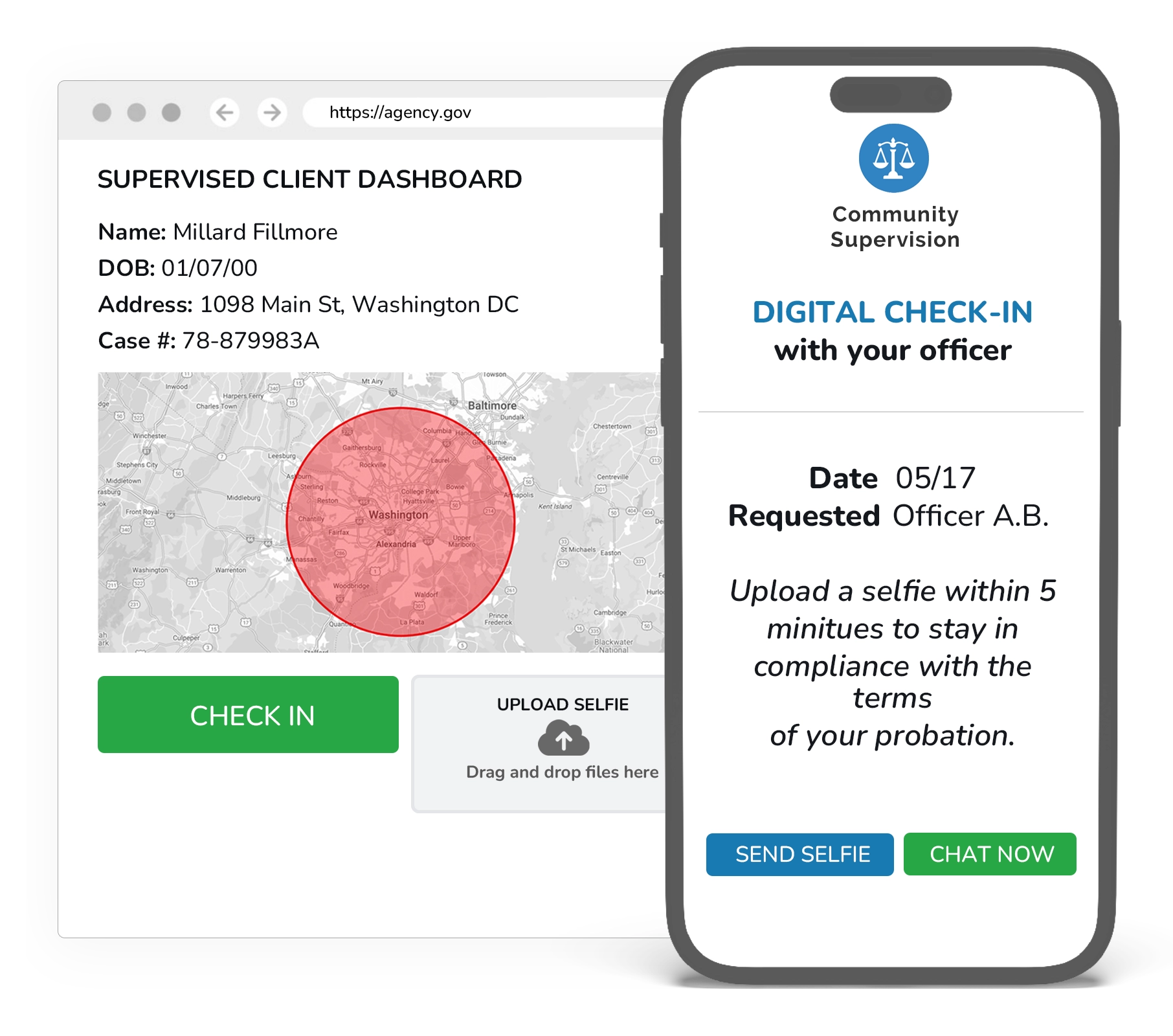
Score risk, run geolocation check-ins, schedule randomized testing, and get alerts on missed check-ins and curfew violations.
Learn moreRisk assessments and scoring
Run validated pretrial instruments such as the PSA, plus eCourtDate’s own predictive scoring, connected to the decision and the supervision plan.
Learn moreAutomated condition reminders
Multi-channel reminders for appointments, drug tests, community service, and other conditions, in 100+ languages.
Learn moreLive video check-ins
Run face-to-face check-ins over native browser video, with nothing for the client to download.
Learn moreOne record per client
Everyone you supervise has a single profile, shared across messaging, scheduling, and supervision, with a self-service portal.
Learn moreViolation and case workflows
Automate violation documentation, hearing scheduling, and stakeholder notification so nothing slips.
Learn moreForms and self-enrollment
Intake and condition forms with conditional logic, publishable to portals and links, feeding straight into workflows.
Learn more
What pretrial and probation supervision includes
CJIS-compliant pretrial and probation case management: the fields on each client record, the supervision workflows that run on their own, and the caseload dashboard officers work from. Every row below is on one record per client, hosted on AWS GovCloud.
| Field | What it holds |
|---|---|
| Risk score | Validated pretrial instruments such as the Public Safety Assessment (PSA), plus eCourtDate’s own predictive score, connected to the release decision and the supervision plan. |
| Conditions | Appointments, drug tests, curfews, community service, and every other condition, each tracked and documented. |
| Check-ins | GPS-verified mobile check-ins and live browser video check-ins, with nothing for the client to download. |
| Testing schedule | Randomized drug and alcohol testing dates, with automated notifications. |
| Contacts and violations | Every check-in, alert, and violation, logged with a complete, exportable audit trail. |
| Portal | A self-service portal on the client’s own profile, shared across messaging, scheduling, and supervision. |
| Workflow | What runs on its own |
|---|---|
| Condition reminders | Multi-channel reminders for every condition, in 100+ languages. |
| Missed check-in and curfew alerts | Alerts to the officer on missed check-ins, curfew violations, restricted-zone entries, and risk-score changes. |
| Violation documentation | Violation paperwork, hearing scheduling, and stakeholder notification, run automatically. |
| Intake and self-enrollment | Intake and condition forms with conditional logic, publishable to portals and links, feeding straight into workflows. |
| Caseload dashboard | The full caseload with risk levels, compliance status, and upcoming deadlines, for each officer and across the unit. |
| Juvenile rules | Notices route to parents and guardians where appropriate, and juvenile records stay confidential behind role-based access. |
From your data to your outcomes
- 01
Bring caseloads onto one record
Import or sync clients and conditions so every person you supervise has a single, current profile.
- 02
Score and prioritize
Validated instruments and predictive scoring sort the caseload by risk, so attention follows need.
- 03
Automate the routine
Condition reminders, check-ins, and testing schedules run on their own, with alerts when something is missed.
- 04
Intervene earlier
Real-time compliance visibility surfaces the warning signs while there is still time to act on them.
Where this gets your agency
Before long, the caseload stops feeling like a flat list where every client competes for the same attention. The routine work, the condition reminders, the testing schedules, the check-in logs, and the violation paperwork, runs on its own, and the clients who need a person rise to the top on their own. Officers start the day knowing who is drifting toward a violation and why, instead of finding out after the fact. Larger caseloads become manageable, not because anyone is working faster or longer, but because eCourtDate carries the parts that never needed a human. Supervision shifts from reactive to proactive, the record behind every decision is complete and defensible, and interventions land while they can still change the outcome.
Up to 40%
Larger caseloads managed effectively
Up to 35%
Fewer compliance violations
Real-time
Visibility into every client
Outcomes the whole agency feels
Attention follows risk
Validated and predictive risk scores sort the caseload automatically, so officers spend their time on the clients who can still be redirected, not on routine monitoring eCourtDate can handle.
Fewer violations, better compliance
Earlier intervention and consistent, documented follow-up reduce technical violations and the jail bookings, hearings, and costs that follow them.
A defensible record
Every check-in, condition, alert, and violation is logged with a complete, exportable audit trail, which lowers agency liability and stands up to court and oversight review.
Compliant, with no infrastructure to run
eCourtDate is CJIS compliant on AWS GovCloud, with SSO and role-based access, and integrates with the systems you already use.
Compliant, accessible, and accountable by default
Every capability runs on the same government-grade foundation. See the security overview.
CJIS compliant
On AWS GovCloud, with SSO, role-based access, and complete audit trails.
TCPA & opt-in
Consent, opt-out, and quiet-hours enforced automatically on every send.
WCAG 2.2 AA
Accessible to the public across every interface and channel.
100+ languages
Automatic detection and translation on every message and portal.
Products built for probation and pretrial services agencies
Start with one and add more as you go. Every product shares the same data, security, and integrations.
Client Management
One record for every person you serve: profiles, photos, tasks, and a self-service client portal.
Learn moreForms & Submissions
A full forms builder with conditional logic: collect, manage, and route submissions into workflows.
Learn moreVisitor Management
Touchless visitor sign-in, digital waitlists, and live queue management for the courthouse.
Learn moreVirtual Hearings & Meetings
Native, browser-based video for magistration, hearings, and live check-ins. No downloads for anyone, plus Zoom, WebEx, and Teams.
Learn moreCase Workflow Automation
Automate the case lifecycle: routing, tasks, jurisdiction deadlines, SLAs, and cross-department coordination.
Learn moreCommunity Supervision
Monitor pretrial and probation clients with risk scoring, geo check-ins, and automated alerts.
Learn more
Frequently asked questions
Common questions from probation and pretrial services agencies evaluating eCourtDate.
What is eCourtDate for probation and pretrial services?
How does risk-based supervision work?
Can officers run check-ins remotely?
How does eCourtDate help officers manage larger caseloads?
Does eCourtDate support juvenile probation?
Is the supervision record defensible and auditable?
Does eCourtDate integrate with our case management system?
Solutions for other agencies
Municipal & Justice Courts
High-volume courts with limited staff need automation that works from day one. eCourtDate handles the repetitive work so clerks can focus on the people in front of them.
County & District Courts
Multi-department courts managing complex case types need a platform that coordinates work across divisions, judges, and locations.
State Court Administration
State offices need statewide consistency, centralized analytics, and the ability to deploy programs across hundreds of courts simultaneously.
Bring eCourtDate to your agency
Get a demo tailored to your agency's workflows.