
Court collections and fines & fees software
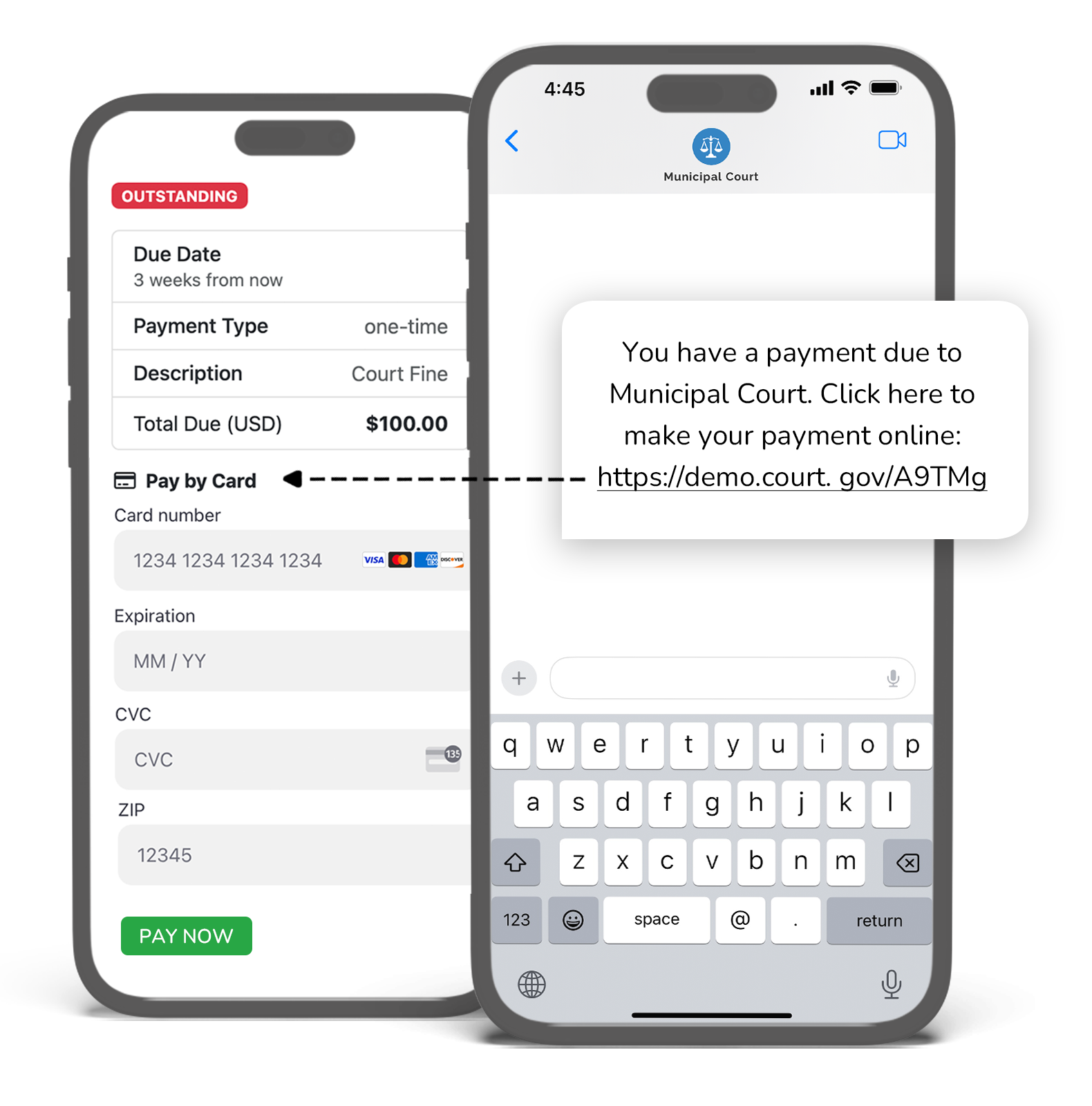
Court finance and collections teams need to assess the right obligation, follow up systematically, and account for every dollar. eCourtDate computes fines and fees from statute, sends multi-channel reminders, distributes revenue across funds, and reconciles, with payments processed by GovPayPlan.
Built for court collections and finance teams
eCourtDate is built for court collections and finance teams: the finance officers, collections units, and fiscal staff responsible for what people owe the court and what the court owes back. These teams assemble obligations from dozens of statutes, chase aging balances, split every payment across state, county, and local funds, and reconcile it all at month end. eCourtDate gives court finance staff one accurate ledger from assessment through collection, distribution, and refund.
Court finance officers
Compute obligations from statute accurately, track collections, and distribute revenue across funds without spreadsheets.
Collections units
Recover more of what the court is owed through systematic, multi-channel reminders and a convenient payment path.
Clerk finance and accounting staff
Reconcile collected funds against obligations and produce audit-ready distribution reports by fund and period.
County and state fiscal and audit teams
Trace any balance to its statutory authority and any distribution to its formula, with a complete audit trail.
The work piling up behind the docket
Balances age out without follow-up
When no system sends the next reminder and there is no convenient way to pay, fines and fees go uncollected and revenue the court is owed quietly disappears.
Obligations are assembled by hand
Court costs, fines, fees, and surcharges come from dozens of statutes that change, and assembling the right total by hand is slow and inconsistent from clerk to clerk.
Ability to pay is hard to apply
Sliding-scale adjustments, waivers, and community-service conversions live on paper, so the balance that reaches a person is often wrong or unfair.
Distribution and reconciliation are a fire drill
Splitting each payment across state, county, and local funds by formula, then reconciling against what was owed, is a recurring month-end scramble in spreadsheets.
What you get
The capabilities court collections and finance teams rely on most, each one built in, configurable, and connected to the rest of the platform.
Fines and fees assessment
Compute the full obligation from configurable fee schedules, with every line itemized and traceable to its authority.
Learn morePayment reminders and plans
Automated balance and due-date reminders by SMS, email, and voice, with payment-plan tracking. Paying happens in GovPayPlan.
Learn moreRevenue distribution and reconciliation
Split collected funds across state, county, and local funds by statutory formula, and reconcile every dollar.
Learn moreBond management and refunds
Track every cash and surety bond from posting through forfeiture, exoneration, and refund on one ledger.
Learn moreRestitution management
Allocate collected funds across victims and cases by priority, keep victims informed, and disburse via GovPayPlan.
Learn moreTime tracking and compensation
Pay attorneys, interpreters, and jurors from verified time, with configurable rates and compensation reports.
Learn moreData dashboards
See assessed, collected, distributed, and outstanding balances in real time, by court, fund, and period.
Learn more
From your data to your outcomes
- 01
Configure your schedules
Build your fines, fees, costs, and surcharges into schedules by offense and case type, and your distribution formulas by fund.
- 02
Assess and remind
eCourtDate computes the obligation, applies ability-to-pay and waivers, and sends multi-channel reminders until the balance clears.
- 03
Collect through GovPayPlan
A one-tap link opens GovPayPlan, which processes fines, fees, and restitution online and in person, PCI-compliantly.
- 04
Distribute and reconcile
Collected funds split across funds by formula, reconcile against obligations, and generate the distribution and audit reports.
Where this gets your finance office
Within a quarter, the numbers stop fighting you. Every obligation is computed from statute and itemized, so the balance a person sees is right and defensible, with ability-to-pay and waivers already applied. Balances stop aging out, because reminders go out on their own and paying is one tap away through GovPayPlan. The month-end split across state, county, and local funds happens automatically, by formula, and reconciles against what was owed, so the report that used to take a week is ready on demand. When an auditor asks how a figure was reached, the answer is one click, not one afternoon.
↑
Collection rates through systematic reminders
One ledger
Assessment through distribution and refund
Audit-ready
Reconciliation and distribution by fund
Outcomes the whole agency feels
Higher collections without added staff
Systematic multi-channel reminders and a one-tap payment path recover more of what the court is owed, with no extra headcount.
Accurate, defensible obligations
Obligations computed from statute, with ability-to-pay and waivers applied, mean the balance people see is right and traceable to its authority.
Distribution and reconciliation, automated
Collected funds split across funds by formula and reconcile against obligations, replacing the month-end spreadsheet scramble.
Compliant and processed by GovPayPlan
eCourtDate runs the assessment and the ledger on CJIS-compliant AWS GovCloud, while GovPayPlan processes payments PCI-compliantly, online and in person.
Compliant, accessible, and accountable by default
Every capability runs on the same government-grade foundation. See the security overview.
CJIS compliant
On AWS GovCloud, with SSO, role-based access, and complete audit trails.
TCPA & opt-in
Consent, opt-out, and quiet-hours enforced automatically on every send.
WCAG 2.2 AA
Accessible to the public across every interface and channel.
100+ languages
Automatic detection and translation on every message and portal.
Products built for court collections and finance teams
Start with one and add more as you go. Every product shares the same data, security, and integrations.
Payment Reminders
Increase collections with automated, multi-channel payment reminders and plan tracking. Paying happens in GovPayPlan.
Learn moreTime Tracking & Compensation
Third parties check in and out from a portal, you set the rates and rules, and timesheets and compensation reports generate themselves.
Learn moreBond Management & Refunds
Track every bond from posting through forfeiture, exoneration, and refund on one ledger. Refunds and payouts run through GovPayPlan.
Learn moreFines & Fees Assessment
Assess the right fines, fees, and costs for every case, apply ability-to-pay and waivers, and produce a clean obligation ledger.
Learn moreRestitution Management
Track court-ordered restitution, allocate collected funds across victims and cases by priority, and keep victims paid and informed. Disbursements run through GovPayPlan.
Learn moreRevenue Distribution & Reconciliation
Split collected fines and fees across state, county, and local funds by statutory formula, reconcile every dollar, and generate the distribution and audit reports.
Learn more
Frequently asked questions
Common questions from court collections and finance teams evaluating eCourtDate.
What is eCourtDate for court collections?
Does eCourtDate process the payments?
How does eCourtDate handle ability to pay and waivers?
Can eCourtDate distribute revenue across funds?
Is eCourtDate secure and compliant for finance data?
Does eCourtDate replace our accounting system?
Solutions for other agencies
Municipal & Justice Courts
High-volume courts with limited staff need automation that works from day one. eCourtDate handles the repetitive work so clerks can focus on the people in front of them.
County & District Courts
Multi-department courts managing complex case types need a platform that coordinates work across divisions, judges, and locations.
State Court Administration
State offices need statewide consistency, centralized analytics, and the ability to deploy programs across hundreds of courts simultaneously.
Bring eCourtDate to your agency
Get a demo tailored to your agency's workflows.