
Jury Operations
Run the whole jury term, from the wheel through juror pay, so no trial waits on jurors and no clerk spends the week before a term on the phone. Summons reach people where they are, qualification and deferrals come back online, and the yield numbers are ready when leadership asks.
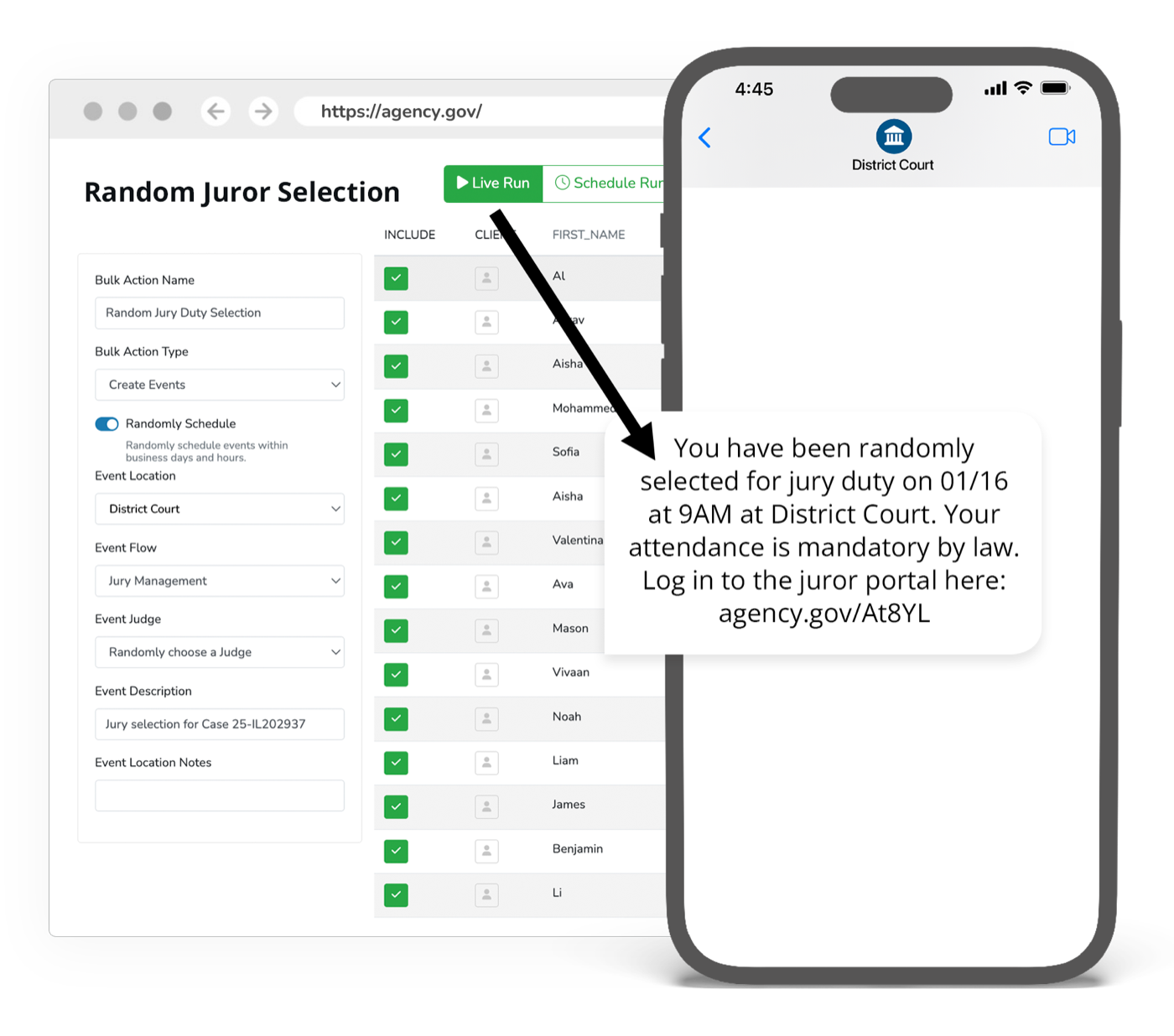
Seat every panel on time, without the paper chase
Run the jury term end to end, from building the pool through paying jurors, so every trial is seated on time with far less paper and phone time.
The yield math never works out
You summon hundreds to seat twelve, and nobody can say where the rest went. Undeliverable, unqualified, exempt, excused, deferred, or simply never showed: without that breakdown, the jury office guesses at how many to summon next term and finds out on the morning of trial whether the guess was right.
No-shows leave panels short
Summoned jurors forget, never confirm, or never got the notice, because a single mailed summons is the only contact they had. Clerks scramble to seat a panel the morning of trial, and judges wait while the office calls a standby list.
The excusal and deferral pile is the week before a term
Requests arrive by phone, mail, and counter visit, each one needing a document, a decision, and a new date. Hand-keying questionnaires and working that pile is what the jury office actually does with the days it should spend building the pool.
A trial settles and 60 people still drive in
When a case resolves the night before, there is no fast way to reach the standby group. Jurors take a day off work to be sent home, the court pays per diem and mileage for it, and every one of them tells a neighbor jury duty is a waste of time.
From your case data to the outcome
- 01
Start the term from a clean pool
Statutory source lists come in and duplicates, deceased records, people who moved, and recent servers come out, so the term starts from a pool that reflects the county instead of a stale list.
- 02
Reach jurors where they are
Summons and reminders go by mail, email, and text with delivery confirmation, and jurors qualify, request an excusal, or defer online in their language. Responses come back in days, and undeliverable notices are visible immediately instead of at the end of the term.
- 03
Draw the panel and run the day
Panels are drawn at random and told exactly where and when to report. When a case settles, the standby group hears before they leave home, and check-in on the morning of trial takes seconds per juror.
- 04
Close the term with numbers
Attendance drives juror pay and mileage automatically, and yield, utilization, and no-show rates are ready to report to the presiding judge or the administrative office without a data pull.
What it does
Full-Term Pool Building
Build the pool for each term from statutory source lists, without hand-keying names or summoning the same person twice.
Multi-Channel Summons
Reach jurors by mail, email, and text with delivery confirmation, and see immediately who was never reached at all.
Self-Service Qualification
Jurors qualify, claim exemptions, request excusals, and defer to a later term online in 100+ languages, without calling the jury office.
Defensible Panel Draws
Draw each panel at random from the qualified pool and keep a reproducible record of how it was assembled if the process is challenged.
Same-Day Standby Control
Tell the standby group not to report the moment a trial settles, so jurors keep their day and the court stops paying for it.
Yield & Utilization Insight
See where every summons goes, from undeliverable to seated, and size the next term’s mailing from real numbers.
The term runs itself, and the numbers are already there
Summonses go out across channels and come back online, so the pool fills in days and the excusal pile is a review queue instead of a week on the phone. Panels are drawn at random from a clean pool, the standby group hears before they leave home when a case settles, and check-in takes seconds. Juror pay calculates from attendance, and when the presiding judge or the administrative office asks how the jury operation performed, the yield and utilization numbers are already assembled. The panel is seated because the pool was full, and nobody stuffed an envelope to get there.
85%
Juror response rate, versus about 45% on paper
100+
Languages for juror communication
10,000+
Courts and justice locations on eCourtDate
What powers this work
This outcome runs on products you can adopt together or one at a time. Every product shares the same data, security, and integrations.
Jury Management
Run the juror lifecycle end to end: source lists and the jury wheel, summons, qualification, deferrals, panel draws, voir dire, attendance, and juror pay.
Learn moreMessaging & Court Reminders
Behavioral, multi-channel reminders that cut failure-to-appear rates and keep every case moving.
Learn moreForms & Submissions
A full forms builder with conditional logic: collect, manage, and route submissions into workflows.
Learn moreWeb Portals
Branded self-service portals for case info, documents, payments, files, and check-ins.
Learn moreTime Tracking & Compensation
Third parties check in and out from a portal, you set the rates and rules, and timesheets and compensation reports generate themselves.
Learn more
Compliant, accessible, and accountable by default
Every capability runs on the same government-grade foundation. See the security overview.
CJIS compliant
On AWS GovCloud, with SSO, role-based access, and complete audit trails.
TCPA & opt-in
Consent, opt-out, and quiet-hours enforced automatically on every send.
WCAG 2.2 AA
Accessible to the public across every interface and channel.
100+ languages
Automatic detection and translation on every message and portal.
Frequently asked questions
Common questions about jury operations with eCourtDate.
How many jurors do we need to summon to seat a panel?
How much of the jury office’s phone volume does this remove?
What happens when a trial settles the night before?
Does eCourtDate improve juror response rates?
How do we show the jury pool represents the community?
Can eCourtDate connect to the systems we already have?
Built for these agencies
County & District Courts
Multi-department courts managing complex case types need a platform that coordinates work across divisions, judges, and locations.
Municipal & Justice Courts
High-volume courts with limited staff need automation that works from day one. eCourtDate handles the repetitive work so clerks can focus on the people in front of them.
State Court Administration
State offices need statewide consistency, centralized analytics, and the ability to deploy programs across hundreds of courts simultaneously.