
Warrant Turnaround
Get a warrant from an officer to a signing judge and back in minutes, with a complete chain of custody, instead of driving paper across the county. Applications route to an available judge, return e-signed, and notify every party automatically.
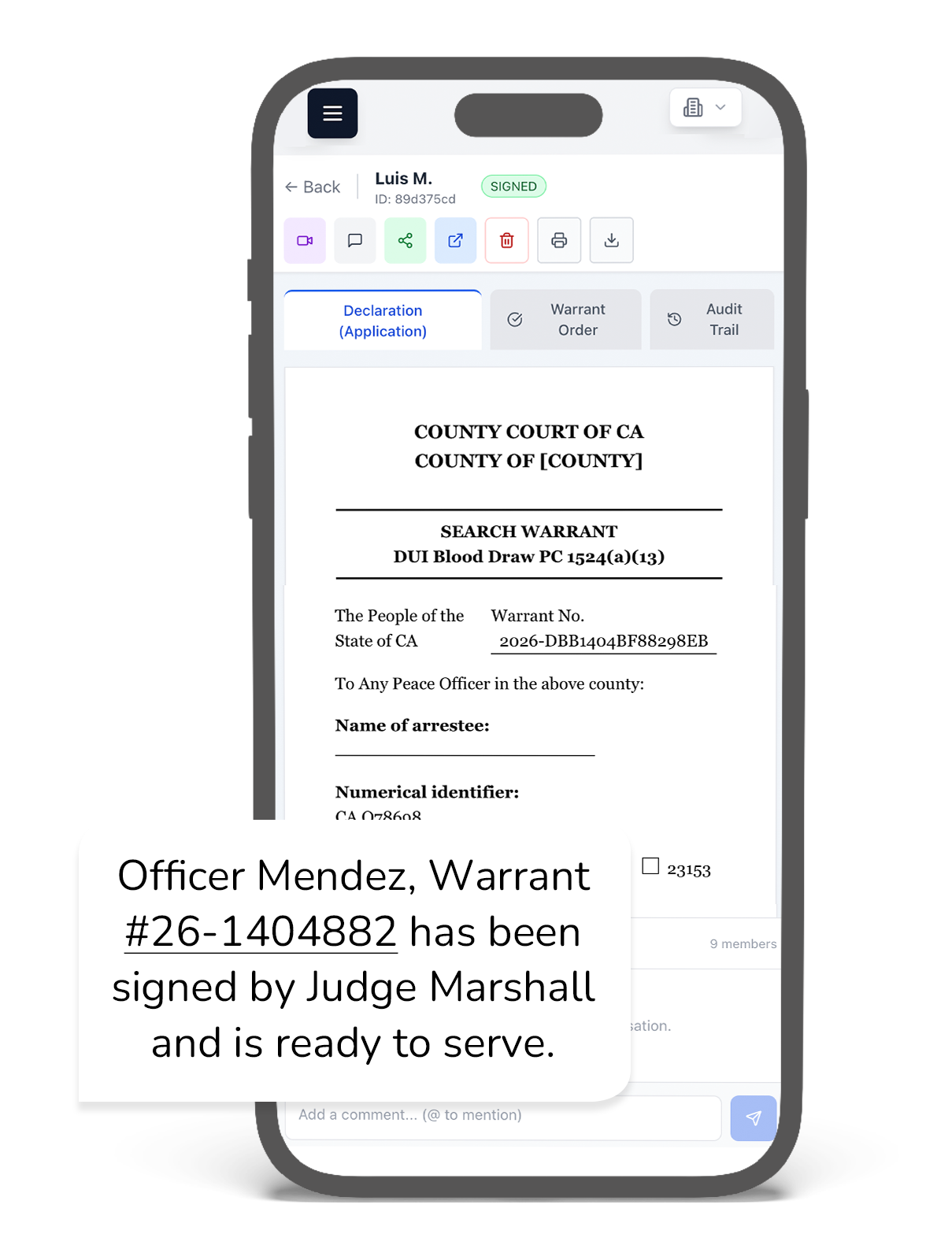
Turn warrant turnaround from days into minutes
Get a warrant from an officer to a signing judge and back in minutes, with a complete chain of custody, instead of driving paper across the county.
A warrant moves at the speed of a car
Paper applications are hand-carried to a judge, signed, and driven back. In the hours that takes, the suspect moves, the scene changes, and the window closes.
Finding an available judge is guesswork
After hours and across jurisdictions, officers call down a list hoping to reach a judge who is on call and reachable. The clock runs the whole time.
Chain of custody lives on paper
A misplaced page or an unclear signature can put an entire warrant, and the evidence behind it, in question in court.
No one can see where it is
Prosecutors, clerks, and officers each ask whether it has been signed yet, because there is no shared, current view of the warrant’s status.
From your case data to the outcome
- 01
Prepare on any device
Officers complete a structured warrant application with required fields, from a laptop or phone, with no missing-page risk.
- 02
Route to a signing judge
The application routes to an available judge by jurisdiction, case type, and on-call schedule, so it reaches someone who can act now.
- 03
Review and e-sign
The judge reviews and signs electronically, with multi-factor authentication confirming identity. The signed warrant returns instantly.
- 04
Track and notify
Officers log service with timestamps and GPS, and prosecutors, clerks, and officers are notified automatically at each stage, all on one immutable record.
What it does
Digital Preparation
Officers prepare warrant applications from any device using structured templates with required fields.
Judge Routing
Applications route to available judges based on jurisdiction, case type, and on-call schedules.
Electronic Signatures
Judges review and sign warrants electronically. Multi-factor authentication ensures identity verification.
Service Tracking
Track warrant service status in real time. Officers log execution with timestamps and GPS coordinates.
Cross-Agency Notification
Prosecutors, clerks, and officers are notified automatically at each stage.
Chain of Custody
Complete digital audit trail from application through execution. Immutable and court-admissible.
The warrant keeps pace with the work
An officer prepares the application and a signing judge has it in front of them within minutes, wherever either one is. It comes back signed, the service is logged, and everyone who needs to know is notified, all on one record that holds up in court. The courier run is gone, and so is the window that used to close while paper was in a car.
Minutes
Warrant turnaround, not days
10,000+
Courts and justice locations on eCourtDate
24
States with deployments
What powers this work
This outcome runs on products you can adopt together or one at a time. Every product shares the same data, security, and integrations.
Electronic Warrants
A complete warrant system: prepare, route, swear in, e-sign, serve, and track, with a permanent chain of custody.
Learn moreMagistration
Run the full first-appearance workflow on one record: arrest intake, the magistration hearing, bail decisions, protective orders, and counsel appointment, configured to your county.
Learn moreVirtual Hearings & Meetings
Native, browser-based video for magistration, hearings, and live check-ins. No downloads for anyone, plus Zoom, WebEx, and Teams.
Learn moreEvidence Management
Securely store, track, and share digital evidence with end-to-end chain of custody.
Learn more
Compliant, accessible, and accountable by default
Every capability runs on the same government-grade foundation. See the security overview.
CJIS compliant
On AWS GovCloud, with SSO, role-based access, and complete audit trails.
TCPA & opt-in
Consent, opt-out, and quiet-hours enforced automatically on every send.
WCAG 2.2 AA
Accessible to the public across every interface and channel.
100+ languages
Automatic detection and translation on every message and portal.
Frequently asked questions
Common questions about warrant turnaround with eCourtDate.
How fast is electronic warrant processing?
How does the system find an available judge?
Are electronic signatures court-admissible?
Can multiple agencies stay in sync?
Can eCourtDate connect to the systems we already have?
Is it secure?
Built for these agencies
Law Enforcement
Officers in the field need digital tools that eliminate paperwork, accelerate warrant processing, and keep the public informed during critical events.
County & District Courts
Multi-department courts managing complex case types need a platform that coordinates work across divisions, judges, and locations.
Jails & Corrections
Jails and corrections agencies need the magistration clock to start at booking, hearings without transport, and supervision that continues after release.
See Warrant Turnaround in action
Get a demo tailored to your agency's workflows.