
Document Intelligence
Turn the documents flowing through the agency into structured, searchable, court-ready data, without manual entry. OCR reads any document, AI classifies and files it, and an immutable chain of custody holds it together.
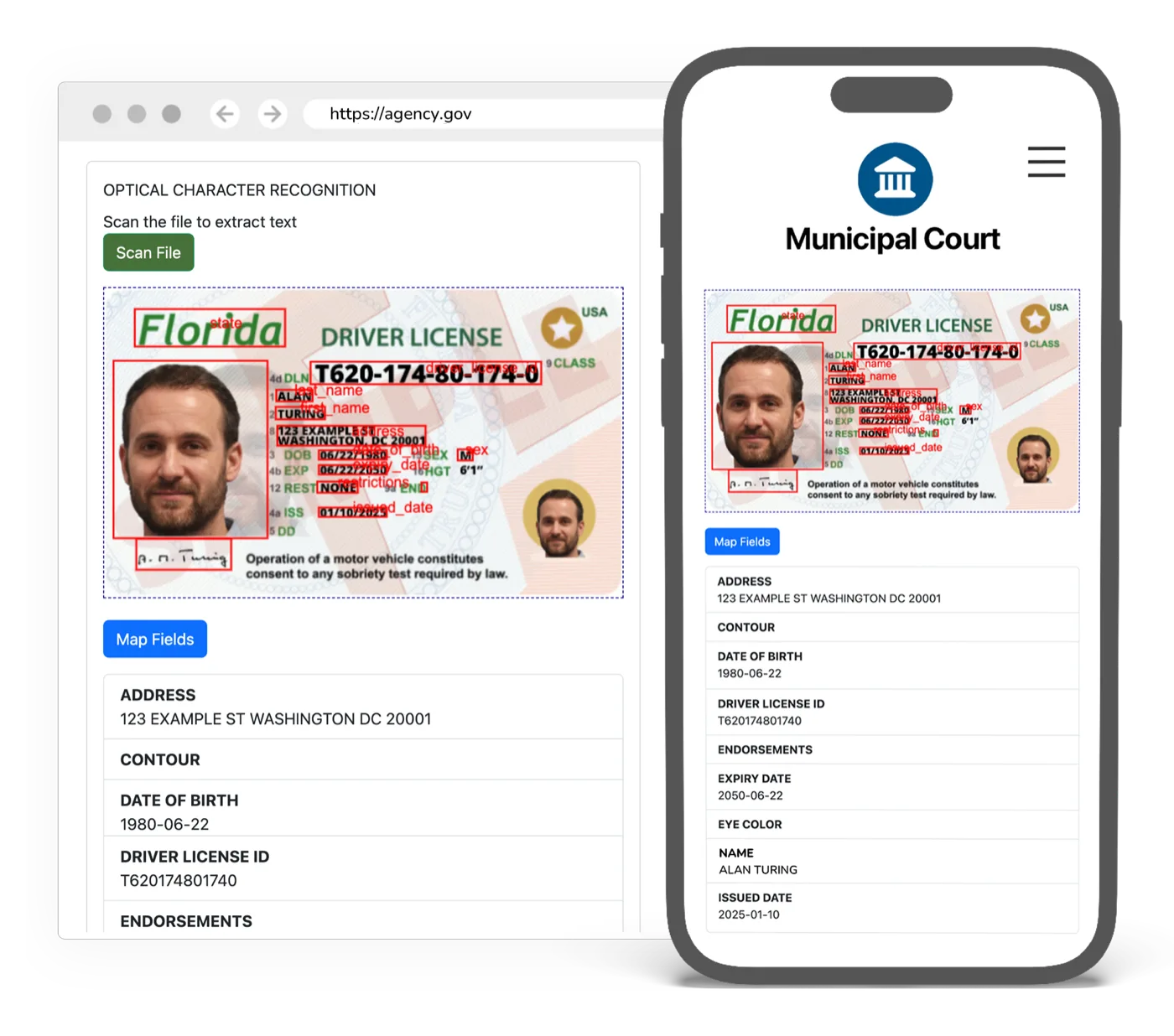
Get the data off paper, without typing it
Turn the documents flowing through the agency into structured, searchable, court-ready data, without manual entry.
Documents arrive as paper and PDFs no one can search
Filings, forms, and records pile up as images, so finding a detail means a person reading page by page.
Manual data entry is slow and error-prone
Typing case details off documents into the system is a chance for every transposition and a tax on staff time.
Documents get filed to the wrong case
Without automated classification, documents get mislabeled or attached to the wrong case, and the error surfaces later.
Chain of custody is hard to prove on paper
When documents move by hand, demonstrating who accessed what, and when, is difficult and risky in court.
From your case data to the outcome
- 01
Read any document
OCR converts scanned filings, forms, and records into searchable, structured text with high accuracy, no manual entry.
- 02
Classify automatically
AI categorizes each document by type, priority, and relevant case, so it lands in the right place.
- 03
Extract the case data
Key details are pulled into structured fields and synced to the case record, removing the re-keying step.
- 04
Hold the chain of custody
Immutable access logs and version tracking record every touch, so the record is court-ready.
What it does
OCR Processing
Convert scanned documents into searchable, structured text with high accuracy.
AI Classification
Automatically categorize documents by type, priority, and relevant case.
Chain of Custody
Immutable access logs and version tracking for every document.
Documents that file and find themselves
Paper and PDFs come in and become searchable, structured data without anyone typing them. Each document is classified, attached to the right case, and logged with an immutable chain of custody. Staff stop keying records and start using them, and finding a detail takes a search instead of a stack.
10,000+
Courts and justice locations on eCourtDate
24
States with deployments
100+
Languages for document translation
What powers this work
This outcome runs on products you can adopt together or one at a time. Every product shares the same data, security, and integrations.
Document Operations
Read, extract, validate, and compliance-check documents with OCR and automated classification.
Learn moreDocument Generation
Generate court documents from templates or AI, collect signatures, and deliver by portal, email, or your own printers and postage meters.
Learn moreElectronic Filing
Run the filing path end to end: guided submission, validation, clerk review, fees and waivers, eService, proposed orders, and docketing.
Learn moreEvidence Management
Securely store, track, and share digital evidence with end-to-end chain of custody.
Learn more
Compliant, accessible, and accountable by default
Every capability runs on the same government-grade foundation. See the security overview.
CJIS compliant
On AWS GovCloud, with SSO, role-based access, and complete audit trails.
TCPA & opt-in
Consent, opt-out, and quiet-hours enforced automatically on every send.
WCAG 2.2 AA
Accessible to the public across every interface and channel.
100+ languages
Automatic detection and translation on every message and portal.
Frequently asked questions
Common questions about document intelligence with eCourtDate.
What does document intelligence do?
How accurate is the OCR?
Does it attach documents to the right case?
Is chain of custody maintained?
Can eCourtDate connect to the systems we already have?
Is document data secure?
Built for these agencies
County & District Courts
Multi-department courts managing complex case types need a platform that coordinates work across divisions, judges, and locations.
State Court Administration
State offices need statewide consistency, centralized analytics, and the ability to deploy programs across hundreds of courts simultaneously.
Prosecutors & Public Defenders
Attorneys need fast access to case documents, streamlined filing workflows, and reliable victim and witness communication.
See Document Intelligence in action
Get a demo tailored to your agency's workflows.